
Research & Studies
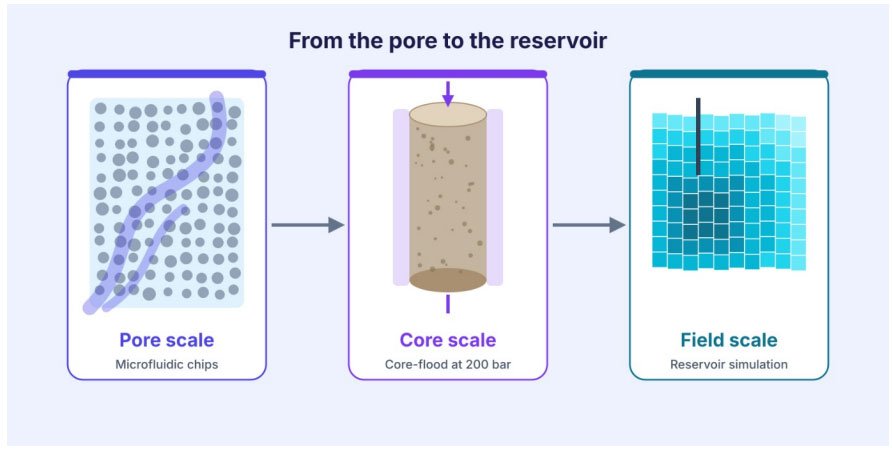
Science from the pore to the reservoir
Our work rests on peer-reviewed research in subsurface flow, hydrogen, geothermal energy and carbon storage, carried out with university partners in India and Europe.
Our approach
We look at the subsurface at every scale. Microfluidic chips show how fluids move through individual pores. Core-flood experiments test that behaviour in real rock at reservoir conditions. Reservoir simulation then scales it up to the size of a field. Each step checks the one before it, so our field recommendations rest on measured physics, not assumptions.
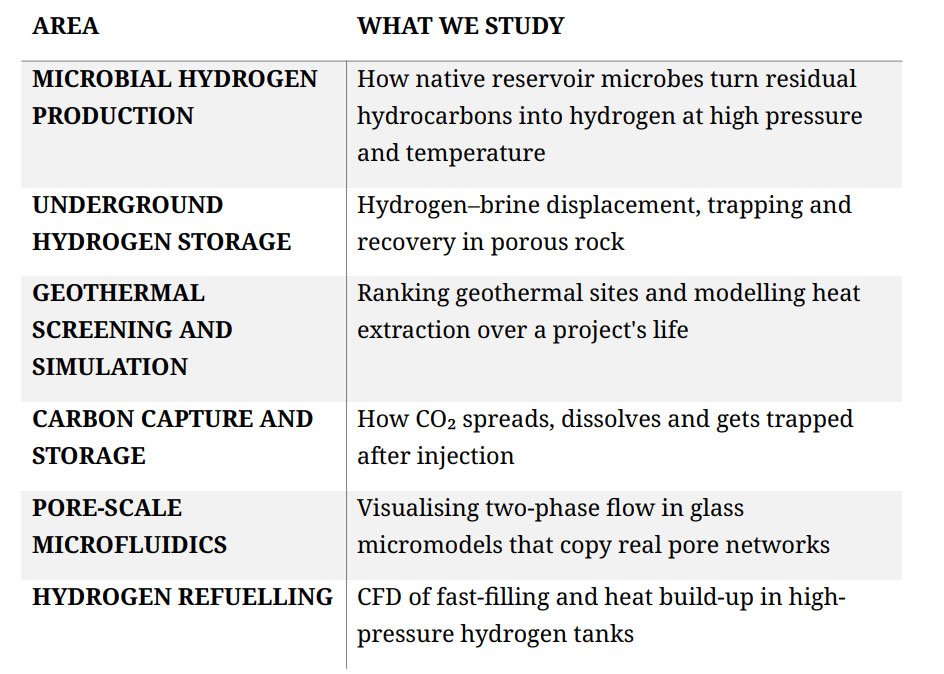
Research areas
Selected publications
- Pal, M., Verma, A. & Malik (2026). Core-flood study of microbial hydrogen generation under reservoir conditions (200 bar, 80 °C).
- Makauskas, P. et al. (2024). Geothermal screening and simulation of Cambrian reservoirs. Energies. The methodology basis for our geothermal service.
- Panwar, Y. S., Kumar, R. & Pal, M. CFD analysis of the hydrogen fastfilling process. Extrica journal.
Patent
LT2024533A (2025): Method and composition for hydrogen production from hydrocarbon-rich reservoirs. Co-inventors include Prof. Mayur Pal. Licensed to Urja Geo Energy for India through GeoTransition Energy UAB.
Ongoing studies
- Hydrogen–brine displacement in microfluidic chips: comparing homogeneous and heterogeneous pore networks to measure sweep efficiency and trapped gas.
- Reservoir models matched to experiments: MATLAB Reservoir Simulation Toolbox (MRST) models calibrated against chip and core data.
- Adapting geothermal screening to Indian basins: applying our published workflow to India's geothermal provinces.
Research partners
- Kaunas University of Technology (KTU), Lithuania
- Delhi Technological University (DTU), India
- GeoTransition Energy UAB, Lithuania
Working on a related problem? We welcome joint studies, student projects and sponsored research with universities, labs and industry.