
CCS
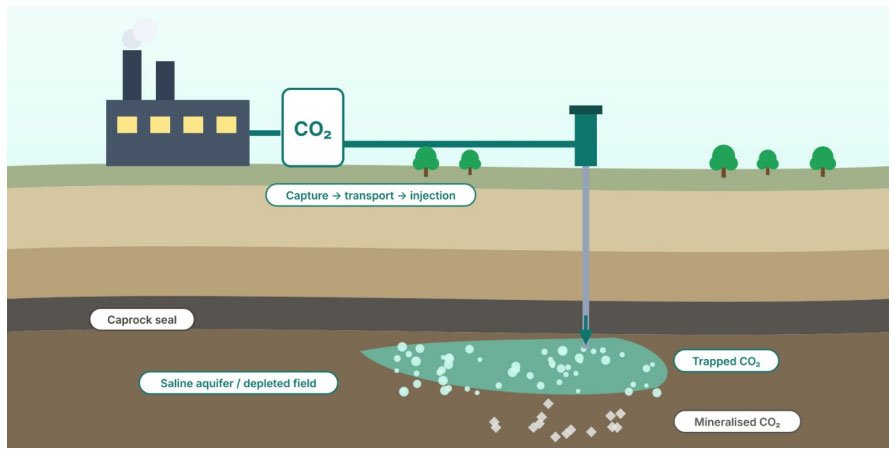
Keeping CO₂ underground, safely and for good
We help industries and operators find, test and model geological sites where captured carbon dioxide can be stored permanently.
Why CCS matters for India
Steel, cement, power and refining will keep emitting CO₂ for years, even as renewables grow. Carbon capture and storage takes CO₂ from these sources and locks it away deep underground. India’s national CCUS policy work and new government funding now make storage site assessment an urgent need. The hard part isn’t capturing the CO₂. It’s proving that a rock formation will hold it safely for centuries. That’s where we come in.
What we offer
- Storage site screening: We rank depleted oil and gas fields and saline aquifers by capacity, injectivity and seal quality.
- Reservoir simulation: We model how the CO₂ plume moves, how pressure builds and how much can be stored over a project's life.
- Pore-scale studies: Microfluidic experiments show how CO₂ displaces brine and gets trapped in the rock's pores.
- CO₂-EOR assessment: We evaluate fields where injected CO₂ can raise oil recovery while being stored.
- Monitoring plans: We design monitoring strategies to track the stored CO₂ and confirm containment.
How CO₂ stays underground
Once injected deep below the surface, CO₂ is held in place by four mechanisms that build up over time:
1. Structural trapping: A tight caprock above the reservoir stops the CO₂ rising. This acts in the first years.
2. Residual trapping: Small CO₂ bubbles get stuck in pore spaces as the plume moves. This happens over years to decades.
3. Solubility trapping: CO₂ dissolves into the salty water in the rock. The heavier brine sinks, so the CO₂ goes down rather than up. This takes
decades to centuries.
4. Mineral trapping: Dissolved CO₂ reacts with the rock to form solid carbonate minerals. This is the most permanent form, over centuries to
millennia.
Our pore-scale research measures the residual and solubility processes
directly, so our models rest on observed behaviour.
Who we work with
- Heavy industry planning capture projects (steel, cement, power, refineries)
- Oil and gas operators with depleted fields or CO₂-EOR potential
- Government and research programmes on CCUS
Planning a capture project? Start with the storage. Talk to us about screening and modelling a site for your CO₂.